

How To Bet On Golf Tournaments
Golf betting has exploded in popularity across India, driven by increased access to international sportsbooks and growing interest in the PGA Tour, DP World Tour, and major championships. Whether you’re following Scottie Scheffler’s dominance, tracking Indian players on the world stage, or simply enjoying a flutter on tournament weekends, betting on golf offers a unique combination of entertainment and opportunity.
Unlike team sports where the outcome hinges on 11 players, golf presents a fascinating landscape: large fields of 150+ competitors, diverse betting markets ranging from simple outrights to intricate prop bets, and odds that shift dramatically as tournaments unfold. For Indian bettors, this guide provides a step-by-step walkthrough of how to safely and responsibly place bets on international golf tournaments through licensed offshore sportsbooks that accept Indian residents and INR deposits.
Is It Legal To Bet on Golf Online From India?
India’s gambling landscape is complex, and understanding the legal nuances before you place your first golf bet is essential. The central government operates under the Public Gambling Act of 1867, which predates online betting and does not explicitly prohibit it. However, many state governments have imposed their own restrictions, and interpretation of federal law varies across jurisdictions. Critically, there is no blanket federal ban on residents betting with offshore licensed sportsbooks—a gray area that most Indian golfers exploit.
In practice, thousands of Indian golf bettors use licensed offshore platforms regulated by authorities like the Malta Gaming Authority, Curacao, or the UK Gambling Commission. These sites accept Indian residents, process bets in INR, and operate legally in their own jurisdictions. Your responsibility as a bettor is to verify the legal stance in your specific state and to use a platform with clear licensing and robust player protections.
Understanding India’s Gambling Laws for Online Golf Betting
India’s gambling laws are primarily state-level, not federal. While some states like Telangana and Odisha have stricter online betting rules, most states do not explicitly ban residents from betting with offshore operators. The Public Gambling Act addresses physical gambling establishments, and online sportsbooks operate outside this framework. That said, you must assume personal responsibility: research your state’s specific regulations before opening an account, and be aware that laws may change.
The key takeaway is that offshore golf betting is not illegal for Indian residents in most cases, but it is unregulated domestically. Using a licensed international sportsbook—rather than an unregistered local site—significantly reduces your legal and financial risk.
What Makes a Golf Betting Site ‘Safe’ for Indian Players?
A safe golf betting site combines three pillars: valid international licensing, strong encryption and player verification, and clear responsible gambling protections.
Licensing is your first checkpoint. Credible sites hold licenses from recognized regulators like the Malta Gaming Authority (MGA), UK Gambling Commission (UKGC), Curacao eGaming, or Gibraltar. These licenses are publicly verifiable and signify that the operator meets strict anti-fraud and player protection standards.
Know Your Customer (KYC) requirements—asking for PAN, Aadhaar, address proof, and ID—are a sign of a legitimate sportsbook. While KYC may seem inconvenient, it protects you by preventing account fraud, money laundering, and ensuring withdrawals reach the correct person. Avoid sites that do not require proper verification.
Responsible gambling tools should include deposit limits, bet limits, self-exclusion options, and clear contact details for support. Before signing up, check the platform’s T&Cs for withdrawal processing times, bonus wagering requirements, and customer support availability in your time zone (ideally IST).
Choosing the Right Golf Betting Site From India
Not all sportsbooks are equal when it comes to golf. Some offer extensive golf markets with 500+ betting options per major tournament; others provide only basic outrights. For Indian bettors, the ideal platform combines deep golf coverage, competitive odds, and seamless INR banking.
| Criteria | Why It Matters for Golf Bettors | What Indian Players Should Check |
|---|---|---|
| Golf Market Depth | Majors and PGA Tour events should offer outrights, each-way, top 5/10/20, matchups, and props. | Browse the sportsbook’s golf section before signup. Check if Masters or US Open shows 20+ betting markets. |
| Tour Coverage | You want access to PGA Tour, DP World Tour, Majors, and India-linked events (e.g., DP World India Championship). | Verify that your target tournaments appear in the golf lobby at least one week before tee-off. |
| INR Support & Payment Methods | Deposits and withdrawals in rupees via UPI, IMPS, NetBanking, or cards avoid currency conversion fees and delays. | Test a small deposit before committing large amounts. Confirm withdrawal times (typically 1–3 business days for INR). |
| Minimum Stake | Golf outrights and some props can have high odds; low minimums (₹50–₹500) allow smaller bets while learning. | Check fine print for minimum stake on different markets. Some sites set higher minimums on live betting. |
| Odds Competitiveness | Odds vary across sportsbooks; even a 5% difference in odds significantly impacts long-term returns. | Compare odds for the same tournament on two sites before placing a large bet. |
| Mobile App & User Interface | A smooth, responsive app in Hindi or English ensures you can place bets and track results on the go, especially during live tournaments. | Download the app and navigate to a recent tournament; test placing a dummy bet to gauge usability. |
| Customer Support | IST-friendly support (live chat, email) helps resolve account, deposit, or withdrawal issues quickly. | Send a test email or use live chat before signup; note response times. |
Key Features of India-Friendly Golf Sportsbooks
When vetting a platform, take these practical steps. First, create a dummy account (or browse without signing up) and navigate to the golf section. Look for depth: are there 10+ markets on the Masters, or just three? Second, test odds on a specific golfer in an upcoming major—compare the same player across two sportsbooks and note the difference. Third, carefully read the bonus T&Cs: many sites offer welcome bonuses in INR (e.g., ₹5,000 on first deposit), but these come with wagering requirements (often 8x–15x the bonus amount) and odds minimums. A bonus is valuable only if you can realistically meet the playthrough before it expires.
Finally, before depositing real money, confirm withdrawal procedures. Does the site require name matching with your bank account? Are there limits on withdrawal amounts per day or week? How long does INR withdrawal typically take? These details prevent frustration later.
Step-By-Step: How to Start Betting on Golf From India
Follow this numbered process to open an account and place your first golf bet responsibly.
- Choose and verify your sportsbook. Select a platform with valid licensing and strong golf coverage (using the criteria above). Open their website or download the mobile app.
- Create an account with a secure password. Use a unique password combining uppercase, lowercase, numbers, and symbols. Avoid reusing passwords from other sites.
- Set a personal deposit limit before funding. Most platforms allow you to set a daily, weekly, or monthly deposit cap in the responsible gambling settings. If you decide to bet ₹2,000 per month, set this limit now. This single step prevents over-spending and keeps golf betting as entertainment, not expense.
- Complete KYC verification. You’ll need PAN, Aadhaar or passport, and a recent address proof (utility bill or rental agreement). Upload these documents. Verification typically takes 24–48 hours.
- Make your first INR deposit. Once KYC is approved, navigate to the deposit section. Choose your method (UPI, debit card, or NetBanking). Deposit your planned bankroll (e.g., ₹5,000). Processing is usually instant for UPI and 10–30 minutes for cards.
- Navigate to the golf section. In the main lobby, find “Golf” or “PGA Tour.” You’ll see a list of upcoming tournaments (e.g., Masters, DP World Tour events, India Championship).
- Select a tournament and choose your market. Click on the event (e.g., “Masters Tournament”). A menu of markets appears: Outright Winner, Top 10 Finish, Head-to-Head Matchups, etc. Start with simple markets like Outright Winner or Top 5 Finish.
- Select a player and enter your stake. Choose a golfer and click on their odds. The bet slip opens on the right. Enter your stake (e.g., ₹500). Review the potential payout shown on the slip.
- Confirm and place your bet. Double-check the player, stake, and odds. Click “Place Bet.” You’ll see a confirmation with a bet ID. Save this ID for your records.
- Track your bet in your account history. Navigate to “My Bets” or “Bet History.” You’ll see all active and settled bets. During the tournament, monitor live scores via your sportsbook’s live updates or external apps like ESPN or PGA Tour’s official app.
KYC, Deposits and Withdrawals for Indian Golf Bettors
KYC (Know Your Customer) is non-negotiable on legitimate sportsbooks. You’ll typically need a PAN card (your primary ID for tax purposes), Aadhaar or passport for identity, and an address proof such as a utility bill, rental agreement, or bank statement dated within the last 3 months. Selfies holding your ID are often required.
Once verified, deposits in INR via UPI, IMPS, or debit card are processed within seconds to minutes. Withdrawals vary: UPI and IMPS withdrawals typically clear within 24–48 hours; card withdrawals may take 3–5 business days depending on your bank. A critical tip: ensure your withdrawal name matches your bank account name exactly. A mismatch will cause the withdrawal to fail and bounce back to your betting account, causing frustration.
Bonuses come with strings. If you receive a ₹5,000 welcome bonus, it may require 10x playthrough (₹50,000 in total bets) before you can withdraw bonus funds. Bets must often be at minimum odds of 1.50 (decimal) to count toward playthrough. Always read the bonus fine print and calculate whether you can realistically meet the requirement before you claim it.
Navigating the Golf Section and Placing Your First Bet
Once logged in, click “Golf” in the main sports menu. You’ll see a calendar or list of upcoming tournaments. The Masters, US Open, The Open, and PGA Championship are always prominent. Click on your chosen event.
The event page displays market tabs: Outright Winner (who will win the tournament), Top 5/10/20 Finish (will your player finish in top X?), Head-to-Head (two-golfer matchups), Props (specific outcomes like “Hole-in-One Yes/No”), and Live Markets (active during tournament rounds).
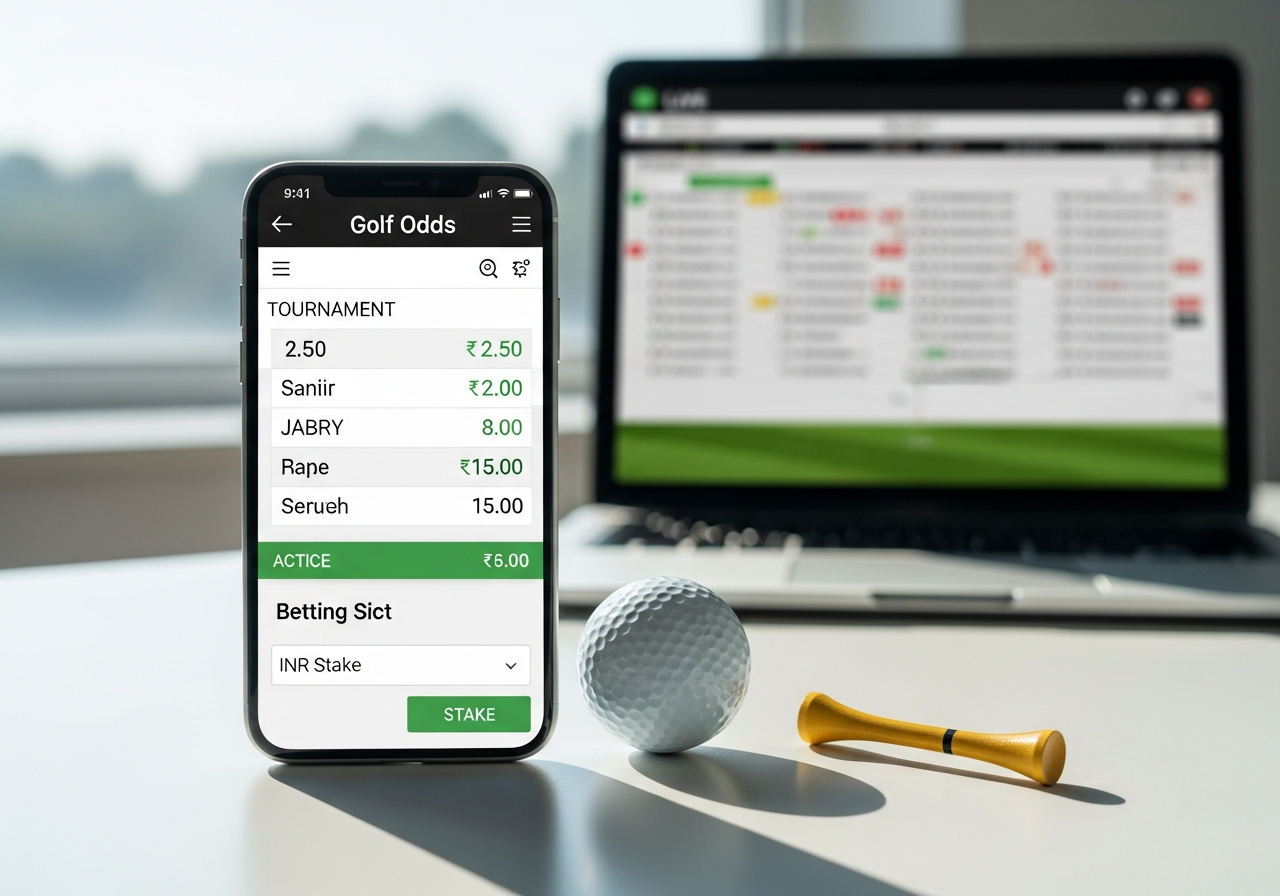
Start with the Outright Winner market. You’ll see a list of golfers with their odds. For example:
- Scottie Scheffler: 2.50 (favorite)
- Rory McIlroy: 8.00 (mid-tier)
- Rishabh Pant (if hypothetically competing): 100.00 (longshot)
Click on a golfer’s odds. Your bet slip opens showing the player name, odds, and a stake input field. Enter your stake (e.g., ₹500). The slip displays your potential payout: ₹500 × 2.50 = ₹1,250 profit (₹1,750 return including stake). If the odds are in decimal format (2.50), multiply stake by odds to get total return. Review carefully and click “Confirm Bet.”
Congratulations—you’ve placed your first golf bet. Your account now shows the active bet in “My Bets.” During the tournament, check live updates. If your player wins, your bet settles as a win within 1–2 hours of the final hole. If they miss the cut or finish outside your market criteria, it settles as a loss.
Core Golf Betting Markets Explained
Golf betting markets cater to every risk appetite. The table below maps the main markets you’ll encounter:
| Market Type | How It Works | Risk Level | Example in INR |
|---|---|---|---|
| Outright Winner | Bet on who will win the tournament outright over 72 holes (or 54 holes for some events). | High (large field) | Bet ₹1,000 on Scottie Scheffler at 2.50 odds = ₹2,500 return if he wins. |
| Each-Way Bet | Split stake: half on win, half on place (top 5 or top 10). Win and place portions paid separately. | Medium (two bets in one) | Bet ₹1,000 each-way (₹500 win + ₹500 place) on Rory at 8.00 odds. Win ₹4,000 if he wins; win ₹1,500 if he finishes top 5. |
| Top 5/10/20 Finish | Player finishes in top X positions, regardless of winning the tournament. | Lower (easier to hit) | Bet ₹1,000 on Collin Morikawa Top 10 at 2.00 odds = ₹2,000 if he finishes top 10. |
| Head-to-Head Matchup | Player A vs Player B; whoever finishes higher wins the bet. Ties often settle as a push (stake returned). | Medium | Bet ₹500 on McIlroy to beat Rahm at 1.90 odds = ₹950 if McIlroy finishes higher. |
| Make/Miss Cut | Bet on whether a player will make the cut (continue to final rounds) or miss it. | Low-Medium | Bet ₹500 on “Sungjae Im Makes Cut” at 1.60 odds = ₹800 if he makes the cut. |
| Hole-in-One | Specific golfer scores a hole-in-one during the tournament. | Very High (rare) | Bet ₹100 on “Scheffler Hole-in-One” at 50.00 odds = ₹5,000 if he aces any hole. |
| Winning Margin | By how many strokes the winner will beat the runner-up (e.g., 1–2 strokes, 3–5 strokes, 6+ strokes). | Medium | Bet ₹500 on “Winner by 3–5 strokes” at 3.50 odds = ₹1,750 if the winner’s margin falls in that range. |
| 3-Ball / Group Result | In a specific grouping (three players), who will shoot the lowest score in that round. | Medium (live or pre-round) | Bet ₹300 on Tiger Woods to shoot lowest in his Friday group at 2.20 odds = ₹660. |
| Round Leader | Who will lead after round 1, round 2, etc. | Medium | Bet ₹400 on the leader after Round 1 at 15.00 odds = ₹6,000 if your pick leads after Day 1. |
| Nationality/Region Bet | An English golfer, American golfer, or player from a specific region (e.g., Asia) will win the tournament. | Medium-High | Bet ₹1,500 on “Asian Player Wins” at 4.50 odds = ₹6,750 if an Asian player wins the tournament. |
| Futures | Longer-term bets (e.g., who will lead after 36 holes, or season-long Tour rankings). | High (extended time frame) | Bet ₹800 on “McIlroy Top 10 in PGA Points” at 1.80 odds = ₹1,440. |
| Player Score Over/Under | Will a specific player shoot more or fewer than a set number of strokes (e.g., under/over 72.5 for the tournament)? | Medium | Bet ₹600 on “Koepka Over 72.5 strokes” at 1.90 odds = ₹1,140 if he shoots above 72.5. |
Outrights, Each-Way and Finishing Position Bets
The Outright Winner is the simplest and most popular golf bet. You pick a golfer to win the tournament. Odds reflect the field size and perceived strength: Scottie Scheffler at the Masters might be 2.50 (implied probability ~40%), while a mid-ranked golfer might be 50.00 (2%). A ₹1,000 outright at 50.00 odds pays ₹50,000—appealing, but the player must win the entire tournament, a rare outcome.
Each-way bets offer a middle ground. Your stake is split in half: one half bets the player to win, the other half bets them to finish in a set place (e.g., top 5 or top 10, depending on field size). If you place ₹1,000 each-way on a golfer at 10.00 odds:
- ₹500 is bet on the win at 10.00 = ₹5,000 profit if they win.
- ₹500 is bet on the place at 1/5 odds (standard) = ₹1,500 if they finish in the place bracket.
- If they win, you win both bets (₹6,500 total return).
- If they place but don’t win, you only win the place bet (₹1,500 return).
Each-way reduces variance compared to a straight outright and is ideal for punters backing mid-odds players.
Top 5/10/20 Finish bets are even more conservative. You’re betting only that a player finishes in the top X positions. A ₹1,000 bet on “Player finishes Top 10” at 2.00 odds pays ₹2,000 if they finish 1st–10th. This is easier to achieve than a win but offers lower odds and smaller payouts.
Advanced Golf Markets: Matchups, Props and Live Betting
As you grow more comfortable, explore these higher-complexity markets:
- Head-to-Head Matchups: Player A vs Player B over the full tournament or a single round. Odds are typically close to 1.90–1.90 (vig-adjusted). If there’s a tie in position, the bet is often a push (stake returned). These are ideal for comparing two similar-strength golfers.
- 3-Way Matchups: Three golfers; whoever finishes highest wins. Example: Scheffler vs McIlroy vs Koepka. The winner’s odds are split three ways, so you might see 2.50 for each. Risk is higher because two must lose for you to win.
- Round vs Tournament: Bet on outcomes within a specific round (e.g., “Scheffler shoots 68 or better in Round 1”) versus full tournament outrights. Round props tighten odds and increase variance; tournaments offer longer odds and lower risk per bet.
- Player Score Over/Under: Will a named golfer shoot above or below a set score for the tournament (e.g., 72.5)? Useful for bettors with strong opinions on a player’s fitness or course fit.
- Birdies/Bogeys Totals: Will a player make more than X birdies or bogeys in the tournament? Niche but interesting for those with detailed stats knowledge.
- Hole-in-One Bets: Specific golfer scores an ace. Long odds (often 50.00–100.00) reflect rarity, but these are fun accumulators (multi-bets) for small stakes.
- Winning Margin: By how many strokes will the winner beat the runner-up? Markets usually split margins into ranges (1–2, 3–5, 6+). Useful for assessing expected competitiveness.
- Wire-to-Wire Winner: Golfer leads after round 1 and wins the tournament. Very difficult; odds can exceed 20.00 even for favorites.
- Live Hole-by-Hole Bets: During a round, bet on who will win the next hole, score birdie/bogey, etc. Highly volatile and best for experienced live bettors.
How Live Golf Betting Works From India
Live betting during tournaments is thrilling but requires discipline. As a round progresses, odds update in real time based on leaderboard changes. If Scheffler is 1-under after 9 holes, his outright odds shorten (e.g., from 2.50 to 2.00). If he drops to 3-over, odds drift (e.g., to 4.00).
Live markets available during play include: Outright In-Play (updated tournament winner odds), Round Leader (who is leading after this round), Next Hole Winner, Player Birdie/Bogey in next hole, and Player Score Over/Under for remaining holes. These are exciting but carry higher implied edge for the sportsbook due to latency.
A crucial consideration for Indian bettors: golf tournaments often begin in the early morning IST (e.g., 6–7 PM IST for PGA events). If you’re placing live bets, you’re often betting at night. Fatigue and emotion (tilt) are real risks. Set a time limit and avoid placing large bets late at night. Use live score apps (ESPN, PGA Tour, or the sportsbook’s own app) to stay updated. Note that there may be a 10–30 second delay between TV broadcast and sportsbook odds, which can cost you if you’re reacting to live TV.
Specialty Props for Majors and India-Focused Events
During the four Majors (Masters, US Open, The Open, PGA Championship), specialty props emerge. Examples include: “Brooks Koepka to make the cut,” “Will Zalatoris to finish Top 5,” “Indian player finish Top 20,” “Hole-in-One at Amen Corner” (Masters-specific), or “Winning margin between 3–5 strokes.”
For Indian bettors, track the performance of Indian golfers like Shubhankar Sharma, Anirban Lahiri, or emerging talent on the world stage. Props like “Anirban to beat [X player]” or “Indian golfer makes cut” offer local knowledge as an edge. Similarly, the DP World India Championship, held in New Delhi, features a field of world-class pros and emerging Indian talent. Local knowledge of how Indian courses play, weather patterns, and player familiarity with home venues can inform value bets.
Props on India-linked events often include: “Indian golfer Top 5 finish,” “Player from [specific country] wins,” or “Leader after Round 1 finishes in Top 3.” These are niche markets with less sharp betting, potentially offering value to informed Indian bettors.
Understanding Golf Odds, Payouts and Value
Golf odds are typically displayed in decimal format (e.g., 2.50, 10.00) on most platforms used by Indian bettors. Decimal odds represent your total return per unit staked: a ₹1,000 bet at 2.50 odds pays ₹2,500 (profit of ₹1,500).
| Odds Format | Example | Implied Probability | Payout on ₹1,000 Stake |
|---|---|---|---|
| 2.50 (Decimal) | Scottie Scheffler outright | ~40% | ₹2,500 total (₹1,500 profit) |
| 3.50 (Decimal) | Rory McIlroy to win | ~29% | ₹3,500 total (₹2,500 profit) |
| 8.00 (Decimal) | Mid-tier golfer outright | ~12.5% | ₹8,000 total (₹7,000 profit) |
| 50.00 (Decimal) | Long-odds outright (e.g., 80th-ranked player) | ~2% | ₹50,000 total (₹49,000 profit) |
| 1.20 (Decimal – Heavy Favorite) | Scheffler Top 10 Finish | ~83% | ₹1,200 total (₹200 profit) |
To calculate implied probability from decimal odds, use this formula:
Implied Probability = 1 ÷ Odds
For 2.50 odds: 1 ÷ 2.50 = 0.40 = 40% implied probability.
For 50.00 odds: 1 ÷ 50.00 = 0.02 = 2% implied probability.
Value betting is the bedrock of long-term profit. Odds reflect the sportsbook’s estimate of probability, but that estimate can be wrong. If you believe Rory McIlroy has a 25% chance of winning (based on form, course fit, odds) but the sportsbook sets odds at 5.00 (20% implied probability), that’s good value—your edge is +5%. Over many bets, value bets produce profit.
Golf’s large fields (150+ players) mean long odds everywhere. Instead of only backing favorites (short odds, high probability, low return), look for mid-odds players where public perception lags reality. A golfer at 15.00 odds with recent top-10 finishes may be undervalued if the broader public has forgotten about them.
Reading Tournament and Round Odds Like a Pro
Tournament outright odds are set weeks before the event. As the tournament approaches and we get closer to tee-off, odds shift based on new information: withdrawals, injury updates, recent form, or weather forecasts. Weather is critical in golf—strong wind can favor long-hitters or punish certain player styles. Follow PGA Tour weather reports in the week before the tournament.
Round-specific odds (leader after round 1, top finisher after round 2) tighten and update daily. If a player leads after round 1, their outright odds will shorten dramatically, reflecting their improved position. If they fall back on Friday, odds drift.
Props (e.g., “Make/Miss Cut”) are priced independently. A player at 10.00 odds to win might be 1.20 to make the cut, reflecting the much higher probability of merely surviving two rounds versus winning the whole event.
Shopping for odds across sportsbooks is essential for serious Indian bettors. Some sites have tighter margins (better odds) than others. Spend 5 minutes comparing odds for the same player on two platforms before placing a large bet. A difference of 0.10 in odds may seem small but compounds over 50–100 bets per year.
What Golf Tournaments Can You Bet on From India?
Golf tournaments span the globe with events throughout the year. Here’s a breakdown of major betting opportunities:
| Tour / Event | Typical Schedule | Why It’s Popular for Betting | Common Markets Available |
|---|---|---|---|
| PGA Tour | August–May (with playoffs) | Largest field depth, most markets, frequent events. Best for regular bettors. | Outrights, Top 5/10/20, Matchups, Props, Live betting. |
| Masters Tournament | April | Iconic event, consistent field, exclusive location (Augusta). High profile odds and props. | Outrights, Each-Way, Top 5/10, Matchups, Hole-in-One at Amen Corner, Winning Margin. |
| US Open | June | Demanding course setup, rewards accuracy. Large field of international players. | Outrights, Top 10/20, Matchups, Props, Round Leaders. |
| The Open Championship | July | Links golf, international emphasis, weather-dependent. Best odds for overseas players. | Outrights, Top 5/10, Matchups, Props, Weather-influenced bets. |
| PGA Championship | May | Strong field, prestigious. Various venues. Moderate market depth. | Outrights, Top 5/10/20, Matchups, Each-Way bets. |
| DP World Tour | Year-round | European/International players. Emerging markets. Good for finding value. | Outrights, Top 10/20, Matchups, Fewer props than majors. |
| India Championship / DP World India Championship | Typically Nov–Dec | Home event for Indian golfers. Local knowledge advantage. | Outrights, Top 5/10, Indian player props, Regional bets. |
| Indian Tour Events | Year-round (varies) | Domestic players, emerging talent. Niche markets. | Outrights, Top 10, Head-to-Head Matchups (limited depth). |
| Ryder Cup & Team Events | Every 2 years (Ryder Cup: Sept) | Team matchups, captain’s picks, nation-based bets. | Match outrights, Team props, Singles match predictions. |
Betting on DP World India Championship and Indian Tour Events
The DP World India Championship, held in November or December at courses like the DLF Golf and Country Club (Delhi) or other premium Indian venues, presents a unique opportunity for Indian bettors. This European Tour-sanctioned event draws world-class players alongside India’s finest, including Shubhankar Sharma, Anirban Lahiri, and rising stars.
To bet on these events, navigate to your sportsbook’s golf lobby and search for “India Championship” or “DP World Tour” events. You’ll typically find:
- Outright Winner (who wins the tournament)
- Top 5/10 Finish (simpler markets than majors)
- Head-to-Head pairings among Indian and international players
- Indian player-specific props (e.g., “Shubhankar finishes Top 10,” “First Indian player Top 5”)
Your advantage here is local knowledge. If you follow Indian golf closely, you may know that a player has recently recovered from injury, performs well at home, or excels in Delhi’s weather. This edge over casual bettors can translate to value bets at longer odds.
Indian Tour events (India’s domestic golf circuit) are less covered by international sportsbooks but do appear on some platforms. These are ideal for experienced Indian bettors with deep familiarity of the domestic scene.
Following PGA and Majors From an Indian Time Zone
Golf tournaments in the US typically have early morning tee times, which translate to 6–8 PM IST starts (depending on daylight saving). The Open Championship in the UK tees off around 3–5 PM IST, more convenient for Indian viewers.
Planning your live betting around these times is critical. If you’re planning to place live bets during a tournament, don’t commit to betting every shot. Instead, use live score apps (ESPN, PGA Tour’s official app, or your sportsbook’s app) to monitor key groups. Set alerts for your player or specific milestones (e.g., “Player reaches -10 for the tournament”). When the moment feels right and odds are favorable, place your in-play bet. If you’re tired or emotional, skip that tournament round and return when fresh.
Practical tip: Record highlights or summaries the next morning and place your research-backed bets before live play begins, rather than reacting emotionally during late-night rounds.
Building a Simple Golf Betting Strategy
Successful golf betting isn’t about predicting every tournament winner; it’s about identifying spots where your edge is clear and betting consistently.
- Start with small stakes (₹100–₹500 per bet) while you learn markets and build your track record. A small loss is tuition; large losses early are demoralizing.
- Focus on 1–2 tours (e.g., PGA Tour and DP World Tour) rather than scattered bets on obscure events. Expertise in two tours beats shallow knowledge across ten.
- Bet early in the week when odds are set but before public money heavily influences them. Early-week odds are often sharper than late-week odds.
- Mix outrights with top-X and matchups. Outrights are high variance; top-10 and matchups lower risk. A balanced portfolio of bet types reduces sweat and emotional rollercoaster.
- Track every bet in a spreadsheet: Player, Tournament, Market, Stake, Odds, Result, Profit/Loss. After 50 bets, analyze: which markets have you beaten? Which player profiles perform well for you? This data guides future bets.
- Avoid chasing long odds only. The thrill of a 100.00-odds payoff is intoxicating, but systematic profit comes from consistent edge, not lottery tickets. Mix long shots (10% of bets) with mid-to-short odds (90%).
- Avoid unrelated player parlays. Betting Scottie Scheffler and Hideki Matsuyama and Cameron Smith in one multi-bet to compound odds sounds fun, but if each is 50–50 to win, a 3-bet parlay is 12.5% likely to hit. Simple bets are more profitable.
Key Factors When Handicapping Golf Tournaments
To form betting opinions, focus on publicly available stats and information:
Strokes Gained Data (available on PGA Tour site): This metric breaks down where players gain/lose shots vs. field average: off-the-tee, approach, short game, and putting. A player leading strokes gained off-the-tee excels at driving length and accuracy. A strong approach player hits greens in regulation. Good putting wins close tournaments. Identify a player’s strength; does the course suit it?
Course Fit: Majors rotate venues. The Masters rewards long hitters; the US Open punishes inaccuracy. The Open is links golf, favoring lower ball flight and finesse. Does your player’s profile match the course? A bomber excels at Augusta; a precision short-game artist excels at a tight, short US Open setup.
Recent Form: Form over the last 4–8 weeks matters. A player with two top-10s in recent starts is hotter than a past major champion in a drought. Check PGA Tour leaderboards or ESPN Golf’s recent results.
Weather and Course Conditions: Wind direction impacts hole difficulty and advantage. Soft greens suit aggressive approaches; firm greens suit conservative play. PGA Tour publishes weather forecasts by week.
Tee-time Waves: In earlier rounds, some tee times are easier (calm morning) than later waves (afternoon wind). A player with a favorable tee time has an edge.
For beginners, start simple: identify the favorite (likely a world top-10 player in excellent recent form), a mid-odds player with recent form and course fit, and a long shot with upside. Compare your estimates of winning probability to implied odds. Bet where odds are favorable.
Bankroll Management and Responsible Golf Betting in India
Bankroll management separates recreational bettors from those chasing losses. Without structure, even profitable bettors can go broke via emotional overbet.
| Practice | Pros | Cons / Risks if Ignored |
|---|---|---|
| Fixed Unit Sizing (1–2% of Bankroll) | Consistent stake size regardless of confidence. ₹5,000 bankroll = ₹50–100 per bet. Limits variance. | If you ignore this and chase losses with ₹500 bets, a 10-bet losing streak depletes you. |
| Monthly Budget Limit | Discipline. If you set ₹2,000/month, you can’t spend ₹10,000 on a single tournament. | Without limits, a losing week triggers desperate “big bets to recover” syndrome. |
| No Parlays on Unrelated Players | Each bet stands alone. One loss doesn’t cascade. Lower variance. | Parlays inflate payouts; they’re tempting. A 3-bet parlay you lose still costs 3x a unit. |
| Betting as Entertainment, Not Income | Protects mental health. No pressure to “recover” losses; losses are entertainment cost. | If you view golf betting as income, losses cause financial stress, leading to reckless chasing bets. |
| Avoiding Bonus Overkill | Low-requirement bonuses add value without forcing excessive betting. | High wagering requirement bonuses (20x+) force you to bet more than planned, increasing loss risk. |
Setting Limits, Avoiding Tilt and Knowing When to Stop
Golf specific emotional pitfalls include: watching a long odd shot miss by one stroke, seeing a lead blown on Sunday, or a favored golfer missing a putt for the win. These gut-wrenching moments trigger tilt—emotional frustration leading to larger, reckless bets.
If you lose a bet and feel frustrated, stop betting for that day. Set a rule: if you hit a daily loss limit (e.g., ₹500 loss), close the sportsbook app and do something else. Reopen your account tomorrow with fresh perspective. Chasing losses—betting larger to recover—is the #1 path to gambling problems.
Most sportsbooks offer self-exclusion (temporary or permanent account closure) and deposit/bet limits (daily/weekly/monthly caps). Use these tools. Setting a ₹2,000 monthly deposit limit before you start prevents you from accessing funds impulsively.
Cultural note for Indian bettors: There’s still stigma around gambling in many Indian communities. If you lose money, avoid shame-driven chasing bets or hiding losses. Treat losses as expected variance in entertainment spending, not failures. If you find yourself betting secretly, lying about amounts, or borrowing money to bet, these are warning signs. Use self-exclusion immediately and seek support from organizations like the National Council for Problem Gambling.
Bonuses, Free Bets and Turnover Requirements
Welcome bonuses in INR (e.g., “₹5,000 match on first deposit”) are common. A site might offer: “Deposit ₹5,000, receive ₹5,000 bonus (10x wagering requirement, odds minimum 1.50).”
This means:
- You deposit ₹5,000 (your money).
- You receive ₹5,000 bonus credit (site’s money).
- You must place ₹50,000 in bets (10 × ₹5,000 bonus) before bonus is withdrawable.
- Each bet must be at 1.50 odds or higher.
If you’re planning ₹5,000 in golf bets anyway, the bonus is valuable—easy to hit the wagering requirement. If you’re a ₹500/month bettor, a ₹5,000 bonus forces you to bet 10 months’ worth in 30 days. Avoid this.
Alternatively, some sites offer free bets (e.g., “₹500 free bet on golf”). These are easier: you bet the ₹500 once (odds minimum 1.50), and if you win, profit is yours (bonus stake returned). Free bets have no ongoing playthrough, making them lower risk.
Rule of thumb: Use bonuses to lower risk, not increase stake size. If a bonus forces you to bet more than planned, skip it.
Common Mistakes Indian Golf Bettors Make (and How to Avoid Them)
- Betting only on favorites: Short odds are “safer” but low-variance and unprofitable. A 2.50 favorite must win 50%+ of the time to break even. Golf fields are large; long odds often represent value. Mix odds.
- Chasing 100/1 longshots exclusively: The thrill of a ₹1,000 at 100.00 odds is intoxicating, but hitting 1% outcomes repeatedly is statistically impossible. Longshots are 5–10% of a balanced portfolio, not 100%.
- Ignoring course and weather: A player’s strength (e.g., driving) must match the course setup (e.g., long course favors drivers). Wind direction changes hole difficulty. Missing this context is an edge giveaway to sharper bettors.
- Over-staking because rupee amounts feel small: ₹1,000 feels like a small bet compared to $100, but currency is irrelevant—only stake percentage matters. A ₹1,000 bet on a ₹10,000 bankroll is 10%, a massive bet. Stick to 1–2% units.
- Betting every tournament without edge: FOMO drives casual bettors to back someone in every event. If you don’t have a clear opinion, skip the tournament. “No bet” is often the best bet.
- Misunderstanding each-way terms: Some bettors place an each-way bet thinking it doubles chances of winning; it doesn’t. You’re placing two bets. If the “place” odds are unclear, avoid each-way until you’re confident.
- Chasing losses after a bad round or tournament: A favored golfer misses the cut, and you’re down ₹2,000. Frustration drives a ₹5,000 bet the next day to recover. Don’t. Losses are part of betting. Move on.
Turning Casual Golf Viewing Into Smart Betting Habits
You watch the Masters every April and maybe bet a few times. To upgrade to structured betting:
- Keep a spreadsheet of every bet: Player, Tournament, Market, Stake, Odds, Result, P&L. After 30 bets, you’ll see patterns: Do I beat the market on “Top 10 Finish” bets but lose on outrights? Am I profitable on majors but lose on regular PGA events?
- Focus on a specific market or player profile where you have an edge. Example: “Recent form, top-100 ranked players at majors, top-10 finish bets.” Specialize and improve depth of knowledge.
- Track form throughout the year. Follow a few tours religiously, read PGA Tour recaps, monitor strokes gained stats, note course changes. Consistent engagement beats sporadic Sunday betting.
- Review and adjust. After a major tournament, review your bets. What worked? What didn’t? Adjust your next strategy. Learning and iteration separate serious bettors from casual punters.
Over time, this discipline transforms golf from occasional entertainment into an activity where you have genuine edge.
—
Golf betting from India is accessible, exciting, and profitable when approached with structure. Choose a licensed sportsbook with deep golf markets and INR support. Complete KYC, set deposit limits, and start with small stakes as you learn markets and build experience. Mix outrights, top-X finishes, and matchups to balance variance. Track every bet, study course fit and player form, and manage your bankroll using fixed unit sizing. Avoid emotional chasing and remember that responsible betting is entertainment, not income.
With patience, research, and discipline, Indian golf bettors can identify genuine edges and enjoy the Masters, PGA Tour, Majors, and DP World India Championship with informed, confident bets.